Showing posts with label Rooney Mara. Show all posts

Wednesday, December 15, 2021

NIGHTMARE ALLEY

Rooney Mara     Bradley Cooper     Cate Blanchett     Willem Dafoe     Mary Steenburgen

Toni Collette     Ron Perlman     Tim Blake Nelson     Richard Jenkins     David Strathairn
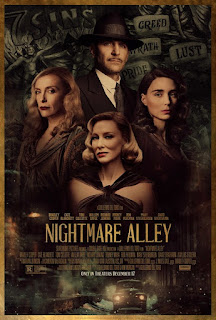
            It’s a nightmare all right.  It starts out with arson by a shady-looking character, and we follow him as he wanders around and ends up at a circus, where he manages to get hired.  Stan Carlisle (Cooper) is smart and a bit of a charmer, and quickly makes friends with the showrunner (Dafoe) and the fortune teller Pete (Strathairn) and his roommate Zeena (Collette), a reader of Tarot cards.  When he learns fast from Pete and begins to offer tips on improving Molly’s (Mara) electrical act, it becomes clear that he has worked in the circus before, and that he doesn’t mind conning people.

            But like all good sociopaths, he draws viewers into his web and we become fascinated with/question more and more of his actions.  Del Toro’s mastery in weaving stories that develop slowly across time, sustain glued-to-the-screen interest with spikes of anxiety and tension is clearly working in Nightmare Alley.  All the characters have potential to be a story unto themselves, but somehow Del Toro and his team integrate all of them into a coherent whole.  He co-wrote the screenplay with Kim Morgan and William Lindsay Graham who wrote the novel on which it is based.

            The filmmakers make the most of their cast headed up by Bradley Cooper who embodies a corrupt phoenix that keeps rising after destruction.  Conning is his game, and it is only the goons [Molly’s protector Bruno (Perlman), a wealthy stooge’s bodyguard, and a psychologist] who recognize his threat.  This role could be a high mark in his career.  Cate Blanchett as a psychologist caught up in his web is icily intriguing as a gorgeous blonde fellow schemer, and as always cinches her role, which I will take issue with below (the role; not the actress).  Rooney Mara pulls off a rather naïve ingenue who eventually picks up on the straits she is in, in an entirely convincing way.  Toni Collette, David Strathairn, and Richard Jenkins are highlights in their portrayals of quirky characters who gradually become endearing in a strange way.

            I found the production to be very entertaining and living up to the filmmakers’ reputation for making a good horror movie that gets into the psychology of human beings and all the myriad of characters that can and do emerge.  Speaking of psychology, I hope that viewers realize that the psychologist portrayed here committed any number of infractions that would revoke her license, let alone try her for crimes.  But as usual, filmmakers seldom consult with professionals in the profession they are portraying.  I got a chuckle out of Dr. Ritter’s sign:  Dr. Lilith Ritter, Psychologist, Ph.D.  It’s Dr. Ritter who earned the Ph.D., which should come with her name, not tacked on at the end.

            Crafts I especially liked about Nightmare Alley are the production design by Tamara Deverell and the cinematography by Dan Laustsen.  Both contributed so much to the mood and subject of the film.


Nightmare Alley has Guillermo del Toro’s mark of provocative storytelling that always includes observations about human nature and ethics.


Grade:  B+                            By Donna R. Copeland


Tuesday, July 24, 2018

DON'T WORRY, HE WON'T GET FAR ON FOOT

Joaquin Phoenix     Jonah Hill     Rooney Mara     Jack Black     Beth Ditto


      I have never given a high grade to a film that was so hard to watch.  Don’t Worry is hard to watch for its realism in depicting addiction and flogging one’s way through it to some kind of resolution.  I have to admit, I had to take breaks while seeing the screener sent to me at home.  For a long while, the viewer has little sympathy for its protagonist John Callahan, beautifully and perfectly rendered by Joaquin Phoenix.  He’s an alcoholic, self-centered, entitled, and dismissive of all rules.  He will get his comeuppance, though, from a car accident after a night of heavy drinking, after which his driver Dexter (played by the inimitable Jack Black in a chameleon role) walks away unscathed, and he becomes a quadriplegic.  
     The film is about what happens after that, which is a long, steep climb.  John is still bucking against society’s rules every step of the way when somehow he stumbles into an Alcoholics Anonymous meeting.  He’s a little taken aback, but the leader that day, Donnie (Hill), captures his attention. What follows is the expected journey of an alcoholic through all the steps of that organization, to forgiveness—of course, the hardest step of all.
     Adopted at birth, John is poignant remembering three things he had learned about his mother:  She was Irish American, red-haired, a schoolteacher—and then the fourth thing:  “She didn’t want me.”  That made such an impression on him, he used it as an excuse to himself and to others for his behavior for years.  “I am an orphan”, he whines.  When he gets to AA, his claim is challenged, partly from questions he can’t answer and partly from stories that are obviously more tragic than his.
   The film is a marvel—and unique—in its depiction of how groups like Alcoholics Anonymous work, in their tedious exploration of each person’s story, confrontation by peers, and wise observations of the leaders.  I was impressed by how so much of it rang true and how helpful  the feedback is from group participants and leaders, a rarity in Hollywood movies.  It shows not only the emotional journey, but as well, problems in dealing with administrative obstacles, including beneficiaries’ trying to exploit the system and myopia of those in charge, e.g., if one is earning money from cartoons, he/she should no longer be deserving of benefits.  
     Gus Van Sant has a reputation for making good movies that reflect social order, populist opinion, and dealing with political issues (Milk, Promised Land, Elephant).  He is good at getting down to the nitty-gritty and showing the fundamental premises.  Here, he shows sensitivity again in his understanding of the psychological underpinnings of addiction and what it takes to overcome its hold.  
      Phoenix is a natural for this kind of role (quirky and resistant, but thoughtful in the end), balanced well by Jonah Hill, slimmed down and in an unusual role for him of a guru-type of figure.  I did not buy the Rooney Mara figure of a stunningly beautiful woman who gives her all to someone like John Callahan. First of all, she is portrayed (although it is not clear) as some kind of therapist, who is so attracted to a man in a wheelchair she goes all in.  If that happened for real, I’m glad in a way, but if it is “added in” to the storyline as a come-on, I’m turned off.

A mostly inspiring story about an obnoxious man who was rehabilitated by life events.

Grade:  B+                                                By Donna R. Copeland

Thursday, July 27, 2017

A GHOST STORY

Casey Affleck     Rooney Mara


     This is truly a story about a ghost, it’s thoughts, reminiscences, and perhaps regrets.  It opens with a couple named C (Affleck) and M (Mara) saying a few words, the most meaningful of which is his saying he’s tired of talking about it, and her asking if they could discuss it tomorrow, and his response is “maybe.”  (The dialog has a Terence Malick touch to it.)  The film sets a mysterious tone right away, with noises in the night, misty smoky air (soft focus used to advantage by cinematographer Andrew Droz Palermo), and a pervasive sense of agitated discomfort—not quite unhappiness.  They are clearly getting ready to move, with boxes everywhere and she hauling things out to the trash. 
      Suddenly, he’s slumped over after a car crash, and then we see her at the morgue, and still later on her own, with C in a white sheet with big eye holes standing over her.  She seems to go through with the planned move, after which a woman with two children moves into their house, but they don’t stay long, what with dishes flying off onto the floor and shattering.  Then we see a party in progress at the same house; it’s crowded, with buzzing conversations and couples slinking off to be alone.  One man pontificates at the table through swigs of beer about life and its uncertainties and disasters.  Next, we see the house abandoned, then a wrecker demolishing it, and an office building goes up in its place. 
     There are numerous indications that the ghost does not like what’s happened, and we next see him out in the country.  A covered wagon comes up, reminding us of the doomsday prognostications of the man at the table, and we think maybe we’re going back in time, or looping around to another world, another of the man’s speculative possibilities.  In the covered wagon is a man with a family, and he is starting preparations to build a house; however, we don’t get to see it finished.
      In the final scenes of the film, we’re back at the house of C and M, and their marriage is recapitulated, giving us more information about their conflicts.  She moved a lot as a child, expressing her dislike by leaving behind little notes hidden just in case if she ever wanted to go back, there would be a little piece of her there.  Did she ever go back to the places she left notes?  No.  Yet, something within her as an adult likes to move different places from time to time; C doesn’t because history of place is important to him.  With this, it makes sense that his ghost is still in the house.  The story resolves in a way that makes all this a little more understandable, but the viewer is likely to remain in puzzlement.
      As I thought about it, it did seem that the writer/director David Lowery (Ain’t them Bodies Saints, Pete’s Dragon) is depicting the sense of loss and the searches humans go through in trying to make sense of the world and stay connected with others, particularly after a loss.  When those issues are not satisfactorily resolved and hopelessness prevails, it’s something like “the end of the world.”  Lowery’s depiction of this experience in the two ghosts (yes, there is another ghost) is graphic and profound.
     I found this an intriguing film that is almost undone by the overly long scenes, such as the opening with C and M together, the pie scene, and the pontification that can’t be easily comprehended.  The near absence of humor also makes this a slog.  Neither Affleck nor Mara—both abundantly talented actors—have enough screen time to warrant their investment in this film.

This is a ghost story without a smidgen of fear, only poetic imaginings.

Grade:  C+                                    By Donna R. Copeland


Saturday, March 11, 2017

SONG TO SONG

Ryan Gosling   Rooney Mara   Michael Fassbender   Natalie Portman
 Christian Bale   Cate Blanchett   Val Kilmer   Benecio del Toro   Holly Hunter   Iggy Pop


     This is a love story about one couple, but generalizes to a broader inclusion of people in general and the natural world.  It’s an Impressionist painting, with story, song, and photography artfully expressed.  Malick has a photographer’s eye that doesn’t follow along the usual frame of plot line, but he gives us impressionistic glimpses of people’s lives and the meanings of it they construct.  Rooney Mara as Faye narrates most of the film, tracing the “dance moves” that made her life what it became.  She starts out as a receptionist for a wealthy man (Fassbender) who is a major force in people’s lives (“people change when they’re around him”, she says).  People come to him as Faye does, hoping he can help them make more of their lives.
     But the man, who is some kind of Titan in the music industry, cannot resist exerting god-like control over people he is mentoring, even while exhorting them to “be free.”   Faye ends up having an affair with him, but after a time meets another man in his orb (Gosling).  The three play, cavorting and frolicking, hoping that it will last forever.  “We thought nothing could break us apart; we made music together.”  Ah, but we are human, and thus in this story the “song to song”, “kiss to kiss” begins, and after betrayal, disappointment, and disillusionment, it finally ends in forgiveness and mercy—at least in one case, which gives us hope.
    There are contrasts drawn between the experiences of men and women, people of privilege and those less fortunate, and individuals with varying degrees of insight and introspection.  The women here seem to be more introspective and self-critical, and searching at first for someone like the wealthy man who will complete them, like Faye the narrator.  Her successor (Portman) says to the same man, “What part of me do you want?  Take what you want from me”, unaware of the bargain she made upon first meeting him when she observed, “you have everything, everything I want.”
     The men have more of a competitive relationship, and their interests are expressed in that realm, with the mentor abrasively scolding the mentee for not achieving more, and the mentee accusing the other of stealing credit for his work, which could be the undoing of their relationship.  We get few clues or evidence of introspection on their part, except for one’s toward the end.
    We get glimpses of those who have come from more modest circumstances encountering the wealth of others, and aspiring to achieve the American dream.  Some are not willing to compromise themselves; others are.  Some learn from their experience and try to change; others are oblivious.  But all experience some kind of regret over the choices they made.
     As much as Song to Song is a portrayal of life as a series of dances and songs with varying partners, it’s also a commentary on trust, fidelity, truthfulness, openness, and honesty in human relationships.  Along with the endearing playfulness (Gosling’s character takes this to the max), we’re reminded of the anguish of betrayal and the pain of separation, but as well the possibility of a “new paradise” in forgiveness.
     The four talented main actors (Gosling, Fassbender, Mara, and Portman) show their skill in responding to Malick’s rather unique direction, and impress with their delightful athletic abilities in dancing and cavorting through all the scenes showing the blooming of new love.  Blanchett’s brief scenes show her power in conveying deep emotion, and cameo appearances of Bale, Kilmer, del Toro, Hunter, Iggy Pop, and still more, provide additional entertainment and scope.  A most impressive appearance is Patti Smith, singing of her love of the photographer Robert Mapplethorpe and through it, giving sound advice to Faye.
     Malick’s teaming with his award-winning partner in cinematography, Emmanuel Lubezki, makes Song to Song a true work of art visually, dramatically, psychologically, and philosophically.

A song of love in many of its manifestations, ending on a high note.

Grade:  A                                                By Donna R. Copeland

Wednesday, October 19, 2016

LION

Dev Patel     Nicole Kidman   Rooney Mara   David Wenham   Sunny Pawar


          This is may be one of the most complicated adoption stories you will ever hear about, and it is based upon a true one.  Saroo (Pawar) is an incredibly industrious Indian child of about five who adores his older brother and wants to go everywhere with him for jobs.  (Their mother is single, supporting three children by gathering rocks.)  They do things like hop on a coal train and take some of the coal to sell in the city.  When Saroo insists on accompanying his brother on a job during the nighttime, Guduu tries as hard as he can to dissuade him.  Finally, the older boy relents, and takes Saroo with him.  When they arrive at their destination on the train, Saroo has fallen asleep and refuses to wake up, so Guduu goes on without him, instructing him to wait on a bench in the train station, and he’ll be back for him.  Time passes, Saroo awakens many times, but no Guduu.  He starts wandering, and realizes too late he is on a train that is moving.
          Saroo ends up in Calcutta where they speak Bengali, but fortunately, many know Hindi, his language.  He wanders the streets for two months, gets picked up by a seemingly kind woman, but manages to escape when he realizes she has bad intentions.  Finally, he is picked up by officials who are charged with getting homeless children off the streets, and put in a kind of orphanage. 
          By something of a miracle—but probably also because of his positive qualities—an Australian couple has asked to adopt Saroo, and he is on the plane to Tanzania.  The rest of the story is about his life there with his new parents, Sue (Kidman) and John (Wenham), and eventually another adopted Indian child who becomes his brother.  Twenty years go by and the story continues with Dev Patel in the role of Saroo. 
         Despite being very happy in his new home, Saroo’s wish to recapture his Indian identity grows to the point he becomes obsessed with it.  He studies maps and train schedules, using Google Earth and his memory of places to figure out where his family might be.  He is sure they have wondered and worried about him all these years, but his separation from them prompts questions about his own identity:  “I’m from Calcutta…no, I’m not from Calcutta; I’m lost.”  His search is made more complicated by the fact that the child mispronounced the name of his hometown and didn’t realize his real name was Indian for ‘Lion.’
          Lion is based on Saroo Brierley’s novel about his life in the 1980’s-90’s, and at the end of the film we are treated to footage of the actual people in the real-life drama.  The film is truly artistic in its presentation by Australian Director Garth Davis (Mini-series “Top of the Lake”) and the cast and crew.  Davis’ directorial work has been nominated for numerous international awards, including coming in second this year for the People’s Choice Award at the Toronto Film Festival for Lion.  Casting for Lion is strong, with Dev Patel and Nicole Kidman already being mentioned as possibilities for Oscar nominations.  The child actor for Saroo, Sunny Pawar, is enchanting in his portrayal of the feisty, smart, industrious boy who combines these qualities with thoughtfulness and caring. 
          Music by Volker Bertelman and Dustin O’Halloran forms a significant component in the film, particularly since there is little dialog in long sequences (e.g., when Saroo is alone and trying to find his brother), and its beauty in mood and tunefulness makes its presence known in every scene.  Cinematographer Greig Fraser likewise makes his work an integral part of the story, with the camera guiding us through mazes in cities and then sweeping through the teeming millions in the city or the breathtaking landscapes of Tanzania.

An intriguing and inspiring “lost and found” story.

Grade:  A                                    By Donna R. Copeland

Saturday, August 20, 2016

KUBO AND THE TWO STRINGS

Voices of:  Charlize Theron   Art Parkinson   Ralph Fiennes   George Takei   Rooney Mara   Matthew McConaughey


            What a perfect blend of visual beauty, creativity, magical stories, and delightful lessons for life!  The American stop-motion animation studio Laika is well known for its quality work (Coraline, ParaNorman, The Boxtrolls), and Kubo and the two Strings represents their best in my opinion.  The visual beauty lies mostly in the sheets of paper that float or spin around and then are instantly formed by origami into magical figures.  But they are not just magical, their identities are revealed in time, and provide a way for a young child to come to terms with the loss of his parents.  The stop-motion animation could be entertaining and appreciated even without the drama, but that’s the icing on the cake.
            The film opens with an undulating sea and a tiny figure in a boat saying mantras to herself to keep her boat on course.  She ends up being tossed on shore and asleep or unconscious.  A baby’s cry awakens her and she runs over to find her infant son wrapped in a blanket.  He has a patch over his left eye.  The full story about them and how they got there unfolds during the course of the film, but in the interim, we see mother and son residing in a remote cave carved in a huge rock formation.  The mother appears older and frail, and her devoted son, Kubo (Parkinson), feeds her and comforts her when she has nightmares.  She tells him wonderful stories, his favorites being about his father.  He has many questions about him, but is always left hanging when his mother forgets.
            During the day, Kubo runs down to the village and tells the same stories in the city square which are illustrated with his magical papers and origami figures.  Plain sheets of colored paper are magically transformed into figures as he relates a tale.  Now, Kubo has been warned many times by his mother not to stay out after dark, but when he hears that during a certain festival people light lanterns and talk to their departed loved ones in the cemetery, he makes his own lantern and tries to talk to his father, not noticing that the sun has set and it’s dark.
            From there, the story becomes an adventure in which Kubo is visited by his ferocious aunts (Mara), witchlike figures out to capture him; thrown with a monkey (Theron), a beetle (McConaughey), and his origami action figures and their weapons, all while being actively pursued.  There are close calls, harrowing battles on land and sea, and a quest.  Kubo eventually learns who the witches are, why he has only one eye, and the full story about his parents.  In the process, it becomes a hero’s journey toward enlightenment and manhood.
            Themes include the value of stories, magic, family, and overcoming evil, mixed in with plenty of humor and adventure.  The interchanges between the monkey and the beetle are wonderfully entertaining in the midst of real threats.  Of deeper import are the observations about death and how memory (the “most powerful magic there is”) in the form of stories keeps loved ones alive forever.  And finally, there is a poignant sequence where an evil man is transformed by making him forget his meanness and defining him as someone charitable and good, giving credence to the idea that the attributions of others influence who we are.
            In addition to the wonders of Laika and Travis Knight’s animation, the voices of Theron, Parkinson, Fiennes, Takei, Mara, McConnaughey, and the Japanese actors provide additional color and meaning to the story.

Animation and story at their best, a film for all ages.

Grade:  A                        By Donna R. Copeland

Friday, November 6, 2015

CAROL

Rooney Mara     Cate Blanchett     Sarah Paulson     Kyle Chandler


           Much has been made of the Lesbian relationship in Carol, but this award-winning film at Cannes (Best actress for Mara and Queer Palm for director Todd Haynes) contains much more in-depth exploration of women in the l950’s, and the trials and consequences in particular of these two women, Carol (Blanchett) and Therese (Mara), who simply don’t fit the mold.  They are independent thinkers, despite Therese’s complaint that “I say ‘yes’ to everything.” The two men (Chandler as Harge and Lacy as Richard) who claim they’re in love with Carol and Therese are completely taken aback and bewildered by the women’s resistance to being appendages.  The rejection is not only mystifying; it’s a painful narcissistic wound for them.
      Therese is a shop girl at a department store and when Carol comes in to buy a Christmas present in the Toy Department, they seem to have an instant awareness and attraction to one another.  Immediately, Therese shows that she’s not a typical 50’s girl when she says she didn’t care much for dolls as a child; she loved trains.  And Carol is then easily convinced to buy her daughter a train when she finds that the doll she was looking for is not in stock.
         This could have been the end of it, except Carol (unconsciously?) leaves her gloves on the counter and when Therese finds them and mails them to her along with the train set, Carol must thank her by offering to take her to lunch.
      The difference in class between the two women is noteworthy; Carol wears an expensive fur and goes to high-end restaurants.  When she orders a martini and quiche for lunch, Therese says she’ll have the same, although in her words, “I barely even know what to order for lunch.”  This difference in background becomes a significant issue throughout the drama that will take place.  The wealthier, older, more experienced Carol could be seen as “toying” with Therese for her own amusement; although this is not born out in the end when Carol shows moral/ethical strengths that are not obvious initially.
          The highly respected and admired Blanchett performs at her usual level of excellence with fine nuances and subtleties.  But Mara is equally good here in playing a younger woman unsure of herself and still in the process of finding out who she is and what she wants in life.  Director Haynes clearly understands women, and with screenwriter Phyllis Nagy has adapted Patricia Highsmith's novel for the screen with knowing grace, utilizing—along with the actors—the talents of musician Carter Burwell and cinematographer Edward Lachman.  Lachman uses light and screen shots to interesting effect, as does Burwell with music anticipating scenes and capturing mood.  The movie takes place at Christmastime, and the carol “Silver Bells” is perfectly apt as the two women embark on a hopeful journey together.
        Carol proceeds slowly and gently as the women’s relationship develops, although there are some jolting surprises that make the viewer sit up straight.  The ending is remarkable when Carol pleads her case in a custody battle with her husband at a meeting in the presence of lawyers, imploring them to keep the interests of their child foremost and arguing reasonably about hers and Harge’s joint responsibilities.  She warns that “a court battle could get ugly, and we’re not ugly people.”

Carol reminds women that even though we have a ways to go, contemporary women can be grateful for the progress that has brought us this far.

Grade:  A-                                               By Donna R. Copeland

Sunday, October 4, 2015

PAN

Levi Miller     Hugh Jackman     Garrett Headlund     Rooney Mara     Amanda Siefried
          Special effects are really the essence of this prequel version of J. M. Barrie’s Peter Pan.  Here, Pan is left by his mother on the steps of an orphanage run by an evil conniving Mother Barnabas (Kathy Burke) when he was a newborn child.  Twelve years elapse, but Peter continues to wonder about his origins and question the motives of the nun who is still in charge of the orphanage.  When he notices that boys frequently disappear during the night, he takes notice and begins to investigate with his friend Nibs (Lewis MacDougall), first in the apartment of Mother Barnabas where he finds many treasures that confirm his suspicions.  But her chest of coins is a puzzlement.
        Soon after, he finds himself captive on a pirate ship owned by the infamous Blackbeard (Jackman) that sails through the sky as well as the ocean.  Their destination is Blackbeard’s mines in Neverland where he conscripts hundreds of boys to hammer through the rock looking for the fairy dust that will keep him forever young.  There, Peter meets Hook (Headlund), who is older but not wiser—more of an operator who takes every opportunity he can to forge an exit from the mines. 
      Through a series of misadventures, Peter comes to the attention of Blackbeard who learns enough about him to determine that Peter is the one to fulfill the prophecy of his own demise.  Of course, that puts Peter’s life in danger, and the rest of the story is his alliance with not only Hook, but also Tiger Lily (Mara), a fairy who has much to fear from Blackbeard as well, because the fairies could be Blackbeard’s undoing in alliance with Peter.
        To be a children’s movie, Pan has complex relationships and plot story lines that will go far beyond their comprehension.  Joe Wright is an accomplished director (Atonement, Pride and Prejudice, Anna Karenina, Hanna, The Soloist), but this film falls far short of his previous work, which could be attributed to a confusing screen play (Jason Fuchs) and special effects that essentially take over and obscure the essence of the story.  Case in point and major flaw is Blackbeard’s and Tiger Lily’s physical bouts that seem to go on forever. 
         Alas, connections to the original story and its principles are nowhere to be found in this modern rendition that looks more like a video game than an enlightening film for children.

Pan is sacrificed to special effects in this traditionally beloved story of Peter Pan.

Grade:  D+                        By Donna R. Copeland